In response to the COVID-19 pandemic, Singapore has undertaken a sweeping implementation of blended learning and one-device-per-student settings across schools. This seminar, providing a researcher’s viewpoint, explores the opportunities and challenges within this educational shift. Leveraging a decade of seamless learning research, our outcomes serve as crucial resources, shaping the nationwide initiative. We delve into the intricate interplay between seamless and blended learning, highlighting conceptual overlaps and distinctive features
Application of Digital Technology in Modern Art and the Film Industry
This hands-on training will guide you through the ins and outs of the user-friendly and free-to-use video editor, Adobe Premiere Rush. Not only will you learn how to navigate and utilize the software effectively, but you’ll also delve into the fundamental principles of good editing. By the end of the workshop, you’ll be equipped with the skills to transform your raw footage into captivating scenes. Whether you’re a beginner or looking to enhance your video editing skills, this workshop is designed to elevate your storytelling to the next level.
This workshop caters to academic and teaching staff seeking innovative approaches to incorporate Generic Intended Learning Outcomes (GILOs) into their courses. Led by Dr. Ricci Fong, the workshop will feature the sharing of VR scenario-based learning materials she has developed. These materials aim to explore the alignment of GILO Rubrics with university teaching and learning. By incorporating AI chatbots and multiple-choice questions, the materials enhance students’ oral communication and social interaction skills, equipping them for practical workplace situations in educational and non-educational sectors. The materials have undergone successful piloting and are gradually being adopted at both undergraduate and postgraduate levels to prepare students for future practicum experiences
The “Learning and Teaching @EdUHK Festival 2024” (the Festival) will be held for four consecutive months from February to May 2024. The theme “Learning and Teaching for Future Readiness” is proposed in view of the strategic development of the University. This year, activities and programme will be organised including open class observations, video showcases, exhibition of poster boards and students sharing. The Festival is organised by the Centre for Learning, Teaching and Technology (LTTC), Faculty of Education and Human Development (FEHD), Faculty of Humanities (FHM), Faculty of Liberal Arts and Social Sciences (FLASS), Graduate School (GS), and School Partnership and Field Experience Office (SPFEO).
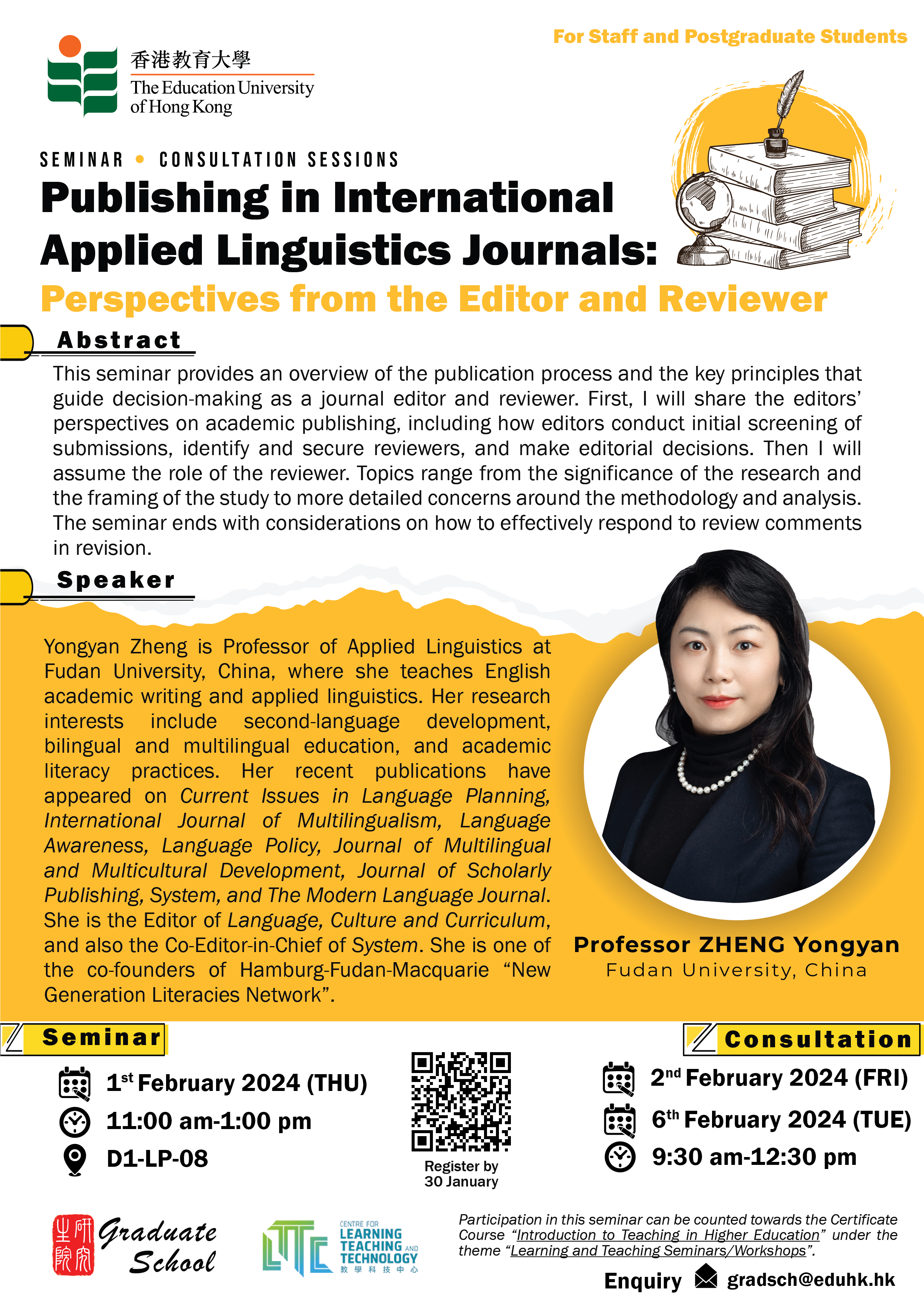
This seminar provides an overview of the publication process and the key principles that guide decision-making as a journal editor and reviewer. First, I will share the editors’ perspectives on academic publishing, including how editors conduct initial screening of submissions,
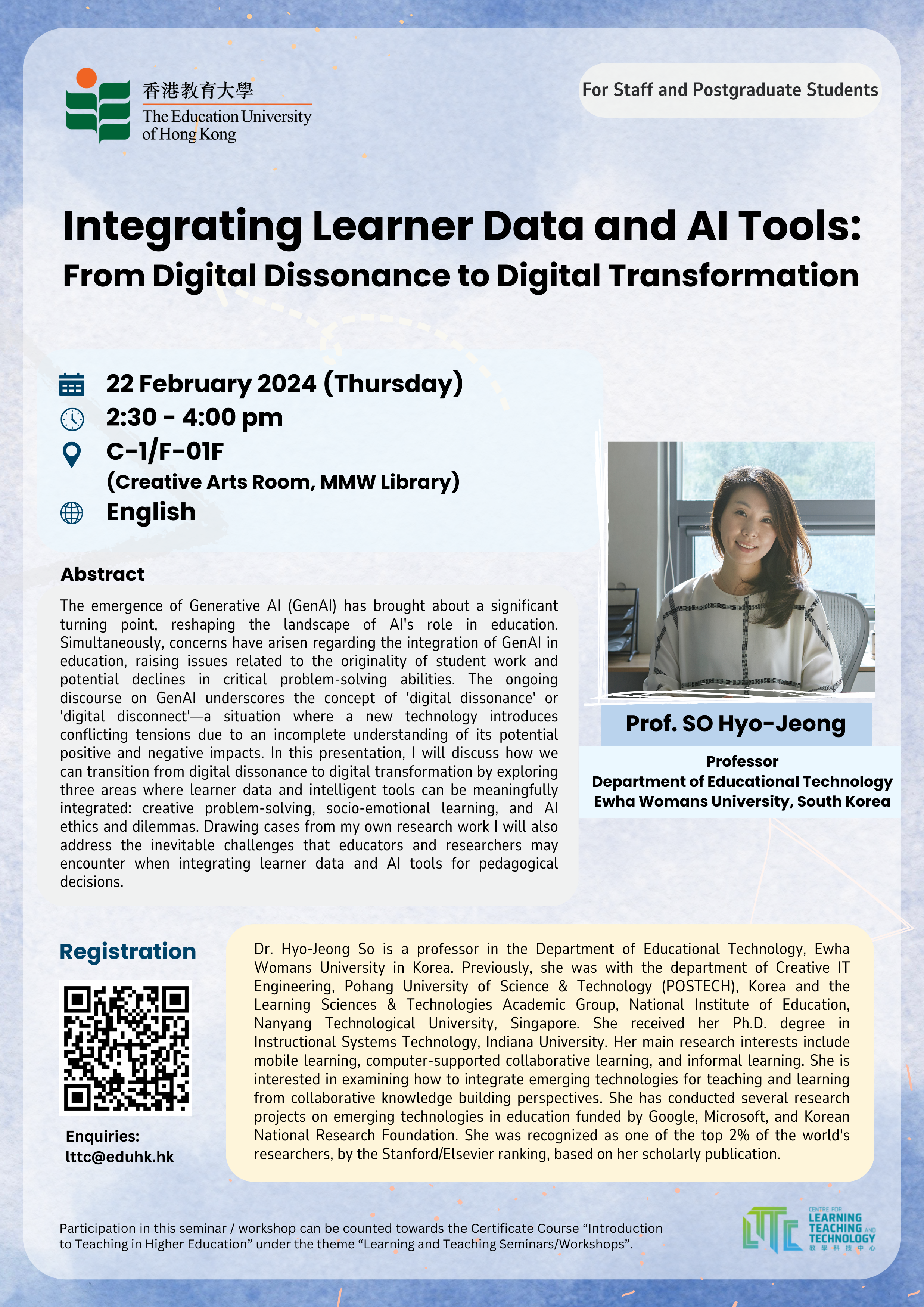
The emergence of Generative AI (GenAI) has brought about a significant turning point, reshaping the landscape of AI’s role in education. Simultaneously, concerns have arisen regarding the integration of GenAI in education, raising issues related to the originality of student work and potential declines in critical problem-
Oral presentation is one of the most widely used methods in assessing student learning outcomes of content comprehension and communication skills. Nevertheless, both students and teachers face challenges in optimizing the benefits of such learning activity.
From students’ perspective, they only receive a letter grade or numerical score but no feedback from the audience (teacher and classmates). From teachers’ perspective, students keep making the same mistakes throughout their course of study. Besides, students’ engagement in classmates’ presentations is problematic.
To address these issues, our team developed “Gongyeh 講嘢”—a peer feedback system for oral presentation. Gongyeh has 4 key features:
(1) the teacher simply uses a mobile device for video recording, and the audience uses their own mobile devices to provide real-time feedback;
(2) the feedback given by the audience is time-synchronized with the recorded video, which are available only to the presenter and teacher;
(3) the feedback is anonymous to the presenter as each audience is represented by a unique emoji, but the real identity is known to the teacher; and
(4) students give peer assessment marks according to rubrics preset by the teacher, so students have a better understanding of how their presentations are being graded. Apart from face-to-face presentation, Gongyeh allows asynchronous feedback with pre-recorded video.