

Loading view.


Learning and Teaching @EdUHK Festival 2024
The “Learning and Teaching @EdUHK Festival 2024” (the Festival) will be held for four consecutive months from February to May 2024. The theme “Learning and Teaching for Future Readiness” is proposed in view of the strategic development of the University. This year, activities and programme will be organised including open class observations, video showcases, exhibition of poster boards and students sharing. The Festival is organised by the Centre for Learning, Teaching and Technology (LTTC), Faculty of Education and Human Development (FEHD), Faculty of Humanities (FHM), Faculty of Liberal Arts and Social Sciences (FLASS), Graduate School (GS), and School Partnership and Field Experience Office (SPFEO).
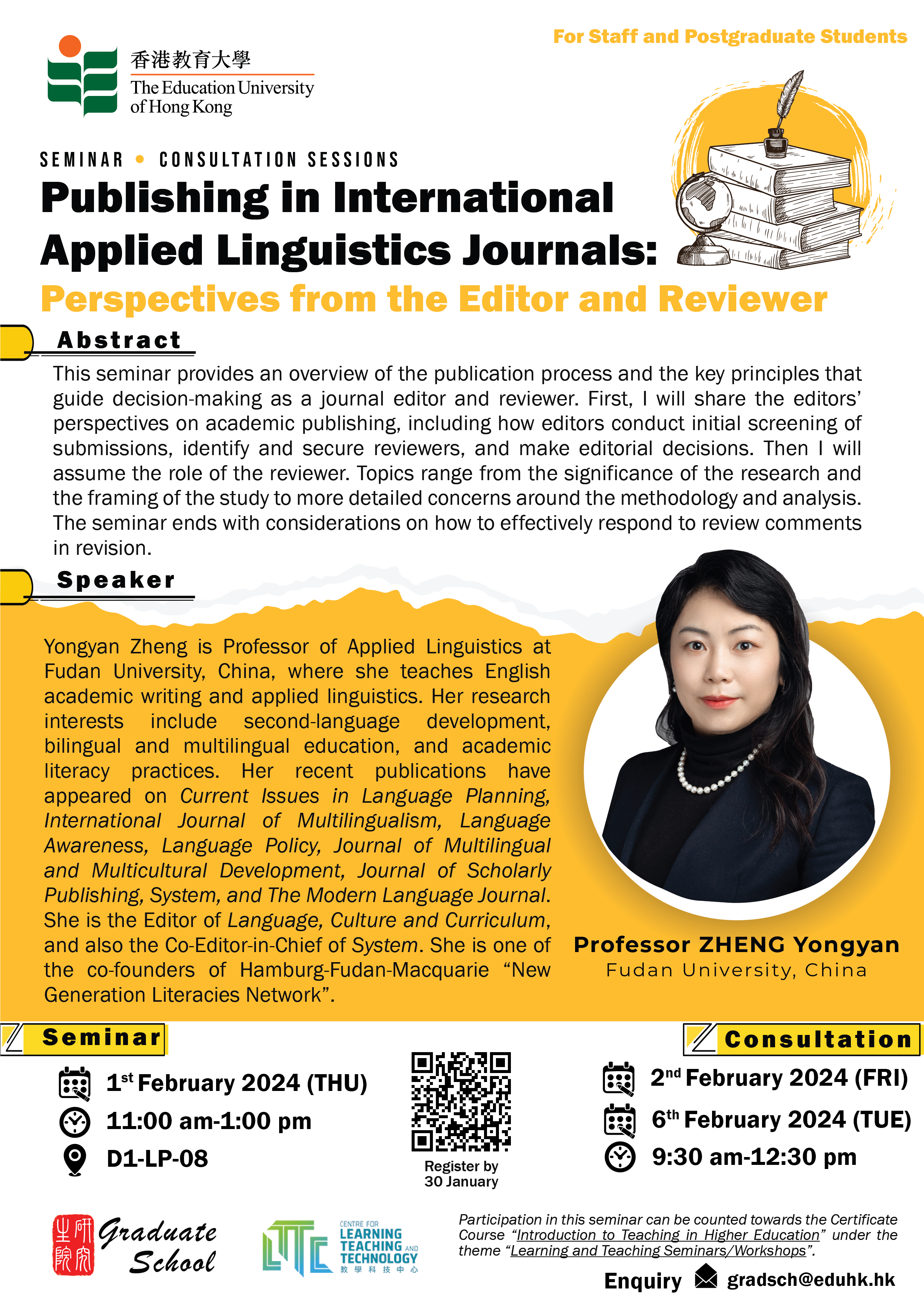
Publishing in International Applied Linguistics Journals: Perspectives from the Editor and Reviewer
online via zoom Online via Zoom
Virtual Event
This seminar provides an overview of the publication process and the key principles that guide decision-making as a journal editor and reviewer. First, I will share the editors’ perspectives on academic publishing, including how editors conduct initial screening of submissions,
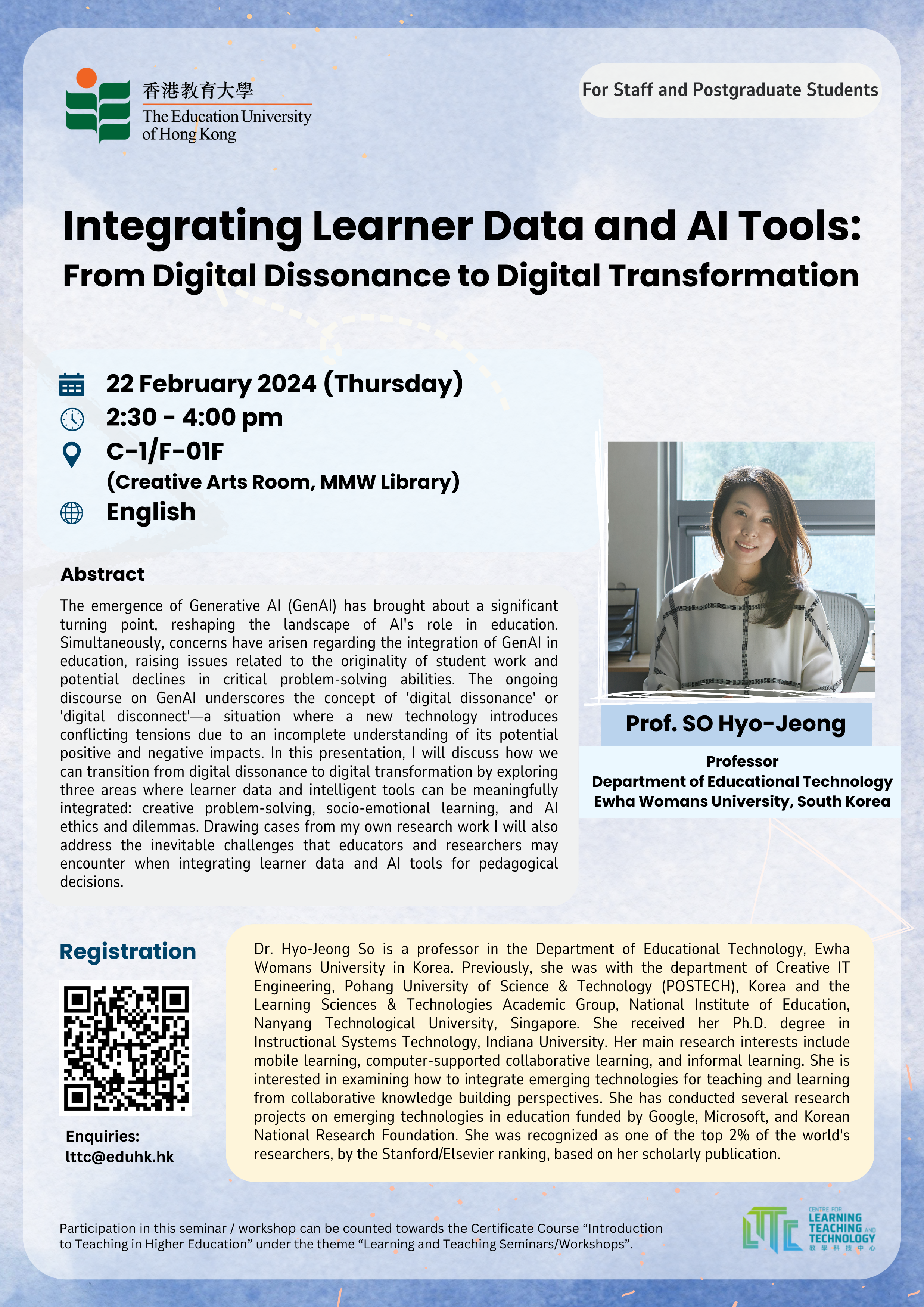
Integrating Learner Data and AI Tools: From Digital Dissonance to Digital Transformation
online via zoom Online via Zoom
Virtual Event
The emergence of Generative AI (GenAI) has brought about a significant turning point, reshaping the landscape of AI’s role in education. Simultaneously, concerns have arisen regarding the integration of GenAI in education, raising issues related to the originality of student work and potential declines in critical problem-

Gongyeh 講嘢: A peer feedback system for oral presentation
online via zoom Online via Zoom
Virtual Event
Oral presentation is one of the most widely used methods in assessing student learning outcomes of content comprehension and communication skills. Nevertheless, both students and teachers face challenges in optimizing the benefits of such learning activity.
From students’ perspective, they only receive a letter grade or numerical score but no feedback from the audience (teacher and classmates). From teachers’ perspective, students keep making the same mistakes throughout their course of study. Besides, students’ engagement in classmates’ presentations is problematic.
To address these issues, our team developed “Gongyeh 講嘢”—a peer feedback system for oral presentation. Gongyeh has 4 key features:
(1) the teacher simply uses a mobile device for video recording, and the audience uses their own mobile devices to provide real-time feedback;
(2) the feedback given by the audience is time-synchronized with the recorded video, which are available only to the presenter and teacher;
(3) the feedback is anonymous to the presenter as each audience is represented by a unique emoji, but the real identity is known to the teacher; and
(4) students give peer assessment marks according to rubrics preset by the teacher, so students have a better understanding of how their presentations are being graded. Apart from face-to-face presentation, Gongyeh allows asynchronous feedback with pre-recorded video.


BookRoll: A Learning Analytics Tool Specific for Reading of Articles
online via zoom Online via Zoom
Virtual Event
Reading is a common part of our courses, but often we have little information about how students read, e.g., how much time they spend on different pages, which parts they have more questions. BookRoll is a learning analytics tool that aims at tackling these needs: BookRoll provides an interface for students to read articles uploaded by teachers while allowing them to add notes and highlight texts of their choice. Students’ reading activities will then be summarised in a dashboard for further scrutiny by teachers. Through this workshop participants will learn how all these can be done with BookRoll through Moodle.

Flying Your Mini-drone with Python and ChatGPT (For Students)
online via zoom Online via Zoom
Virtual Event
Unmanned Aerial Vehicles (UAVs), commonly known as ‘drones’, are aircraft piloted remotely by an operator. A drone is a way to teach real-world examples of coding in action, demonstrating principles of flight and physics. Therefore, drones have been helpful in organising and developing STEM/STEAM activities.
In this workshop, you will learn how to fly an educational drone (DJI RoboMaster TT). You can have opportunities to learn Python by programming drones to design flying trajectories and accomplish autonomous flying missions. Furthermore, you will learn to apply ChatGPT for programming, enhancing your drone’s capabilities to understand and execute natural language commands. This unique combination of Python scripting and AI-powered conversation creates a new dimension in drone interaction and functionality.

Inspiring Learning Innovations for Meaningful Engagement Through Teach Less, Learn More (TLLM) Initiatives
online via zoom Online via Zoom
Virtual Event
The implementation of Teach Less, Learn More (TLLM) initiative aims to achieve educational goals effectively by reducing content quantity while injecting higher quality teaching process through utilization of inspiring and innovative learning pedagogies. By redesigning physical and virtual learning space, this initiative scaffolds learners towards development of essential competencies and shape their own learning. Various transformational journeys implemented at Taylor’s University in Malaysia will be shared in this session, including Global Classroom that combines teaching excellence with learning innovation, the elements of virtual learning design in creating a meaningful hybrid learning experience, as well as the University’s ongoing efforts to enhance virtual, interactive, and immersive learning in an extended reality environment.

Building Your Intelligent Vehicle with Automatic Control System Programming (For Students)
online via zoom Online via Zoom
Virtual Event
The Centre for Learning, Teaching and Technology (LTTC) offers the following workshop on Building Your Intelligent Vehicle with Automatic Control System Programming. This workshop is ideal for all students, researchers, and professionals interested in robotics and automation.
An intelligent vehicle is an advanced robotics sensing technology capable of performing tasks such as sensing objects, following lines, and avoiding obstacles. In this workshop, you can have an introduction to the fundamentals of robotics and automation, the entire building process of automatic robotics vehicles and hands-on experience in building a robotics vehicle with various electronic components, software and C++ programming language. The workshop covers essential topics such as autonomous driving systems, intelligent lighting control systems, photodetectors, etc. By the end of the workshop, you can have a solid understanding of the key concepts and technologies used in intelligent vehicles and be able to apply them to your projects and interests.


